An in-depth technical exploration of how PhysBox: Volt bridges physical ESP32/CYD microcontrollers with WASM SPICE models, and how PhysBox: Mesh translates parametric WebAssembly geometry into 3D prints, laser-cut finger joints, CNC G-code toolpaths, and live WebSerial machine control.
Connecting real ESP32 & Cheap Yellow Display (CYD) microcontrollers directly into the browser's WebAssembly SPICE solver at 460,800 baud with zero buffer starvation.
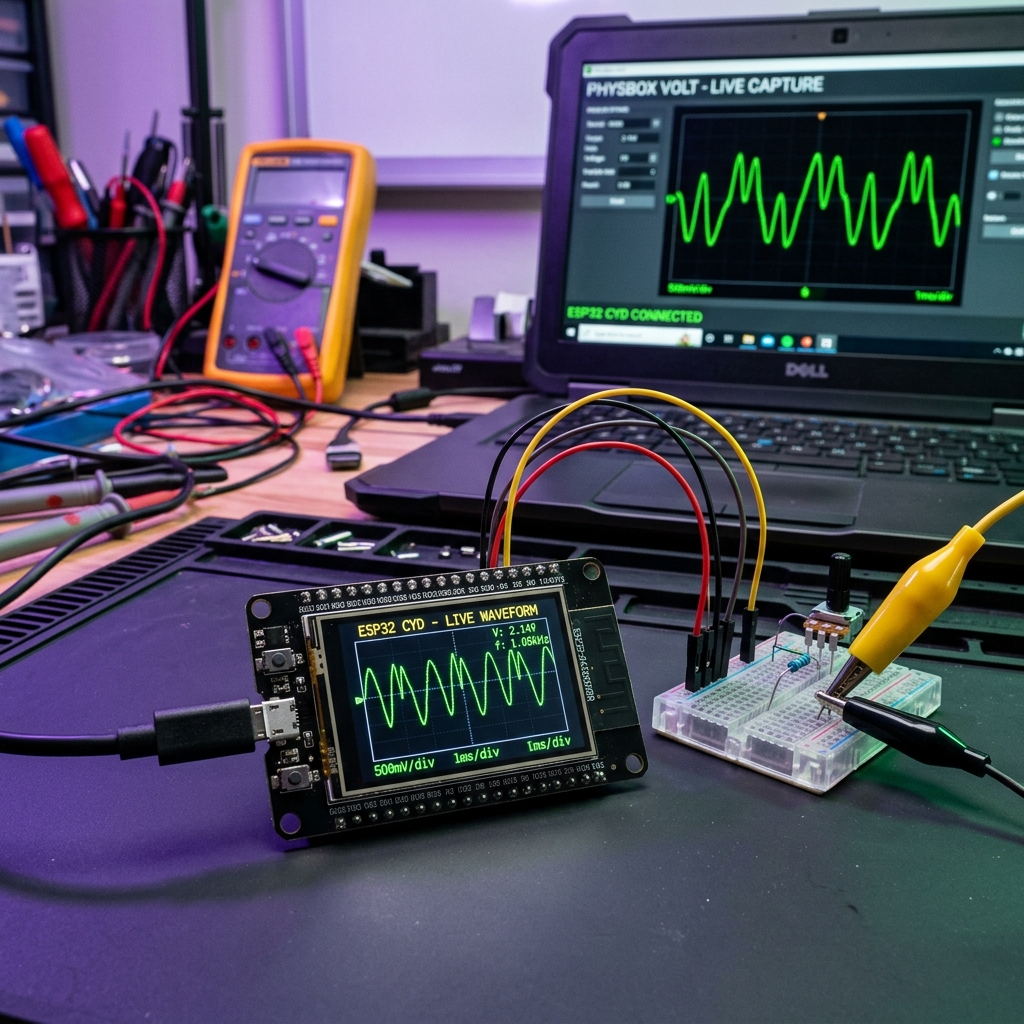
In traditional EDA, firmware execution is either completely synthetic or disconnected from physical hardware — the schematic and the silicon never meet. PhysBox Volt introduces a dedicated Serial & WebSocket HIL Bridge running at up to 460,800 baud.
Physical microcontrollers read ADC inputs from external analog sensors, execute custom MicroPython or C++ firmware logic, and stream pin states back to the browser worker thread.
Buffers simulation steps to absorb serial transmission jitter and maintain synchronized hardware I/O timing.
Computes digital logic switching thresholds in real time based on simulated analog rail voltages.
Route live physical microphone audio into input nodes and feed synthesized DAC output straight to system speakers.
MicroPython and C++ native firmware routines package multiple I/O states per packet for maximum baud-rate efficiency.
import machine, time, select, sys

# Initialize UART at high-speed 460800 baud for PhysBox Volt HIL Bridge
uart = machine.UART(1, baudrate=460800, tx=22, rx=23)
adc = machine.ADC(machine.Pin(34))
dac = machine.DAC(machine.Pin(25))

print("[HIL] Connected to PhysBox Volt SPICE Engine")

while True:
    if select.select([sys.stdin], [], [], 0)[0]:
        cmd = sys.stdin.readline().strip()
        if cmd.startswith("DAC:"):
            val = int(cmd.split(":")[1])
            dac.write(val) # Update physical DAC output from WASM circuit model

    raw_val = adc.read()
    # Batch telemetry: ADC raw value + timestamp tick
    uart.write(f"ADC:{raw_val}:{time.ticks_us()}\n")
time.sleep_us(500)Generate procedural CSG geometry in client-side WebAssembly, verify 6-DOF mechanical joint mechanics in MuJoCo, and export slicer-ready Z-Up STL files for physical fabrication.
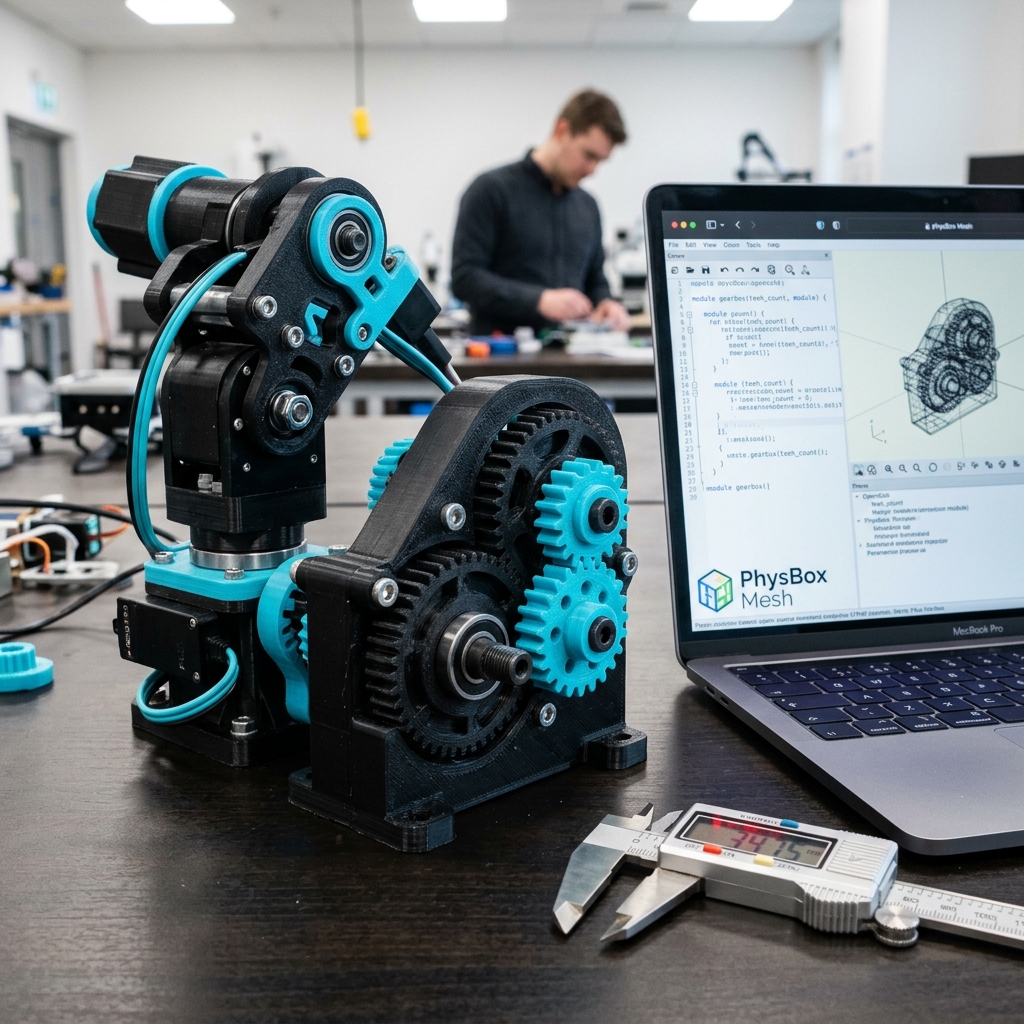
PhysBox Mesh embeds a custom-compiled WASM OpenSCAD compiler directly inside the browser. Write code live in the node inspector, preview 3D solid geometry in WebGL, and test kinematic constraints without leaving the tab.
Once mechanical tolerances and 6-DOF joint constraints pass in MuJoCo WASM, click Export STL to generate perfectly oriented Z-Up STL files for immediate printing.
OpenSCAD annotations like // [min:step:max] automatically create interactive GUI sliders for live parameter tuning.
Z-Up STL export formatted specifically for PrusaSlicer, Bambu Studio, and Cura with zero manual axis rotation needed.
Solve gear, rack, and pinion interactions via rigid mathematical constraints or test pure 6-DOF mesh tooth friction.
Prevents unit scale errors (e.g. mm vs meters) before geometry is sent to your 3D printer.
Unfold 3D assemblies into 2D sheet space, auto-generate interlocking finger joints with kerf compensation, compute CNC dogbone corner reliefs, generate GRBL G-code, and stream live over WebSerial.
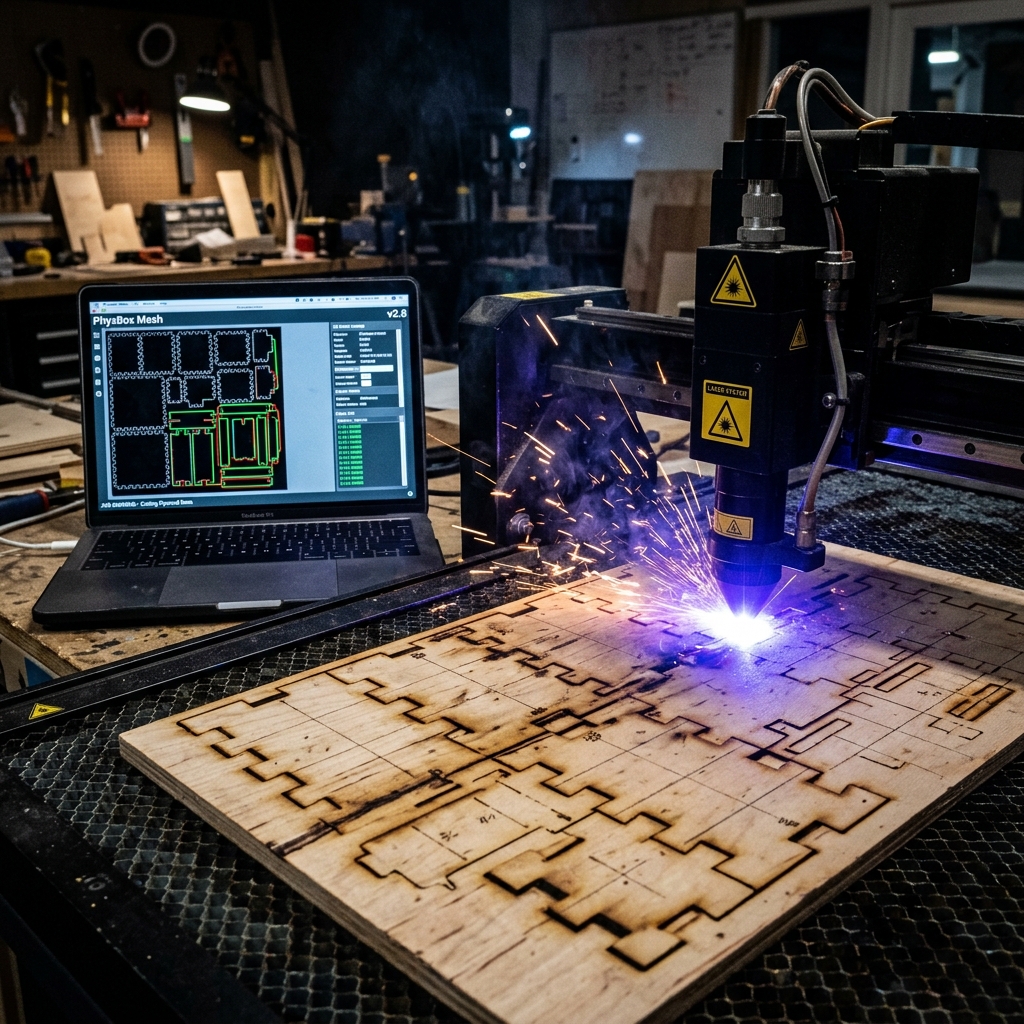
PhysBox Mesh isn't restricted to additive 3D printing. It features a complete subtractive manufacturing engine (`laserCutExporter.ts` and `gcodeExporter.ts`) designed for Laser Cutters (LightBurn, Glowforge, LaserGRBL) and CNC Routers (GRBL, Marlin, ShopBot).
The engine automatically unfolds 3D panel meshes onto 2D sheet stock using maximal-rectangle packing algorithms, generates structural tab-and-slot joints, applies kerf/clearance adjustments, and streams G-code straight to machine hardware over WebSerial.
Generates tight press-fit tab-and-slot joints with kerf compensation, clearance tuning, and custom tab width across panel edges.
Calculates corner overcuts so spinning round CNC end mills can seat square 90° mating tabs without manual CAD edits.
Slices arbitrary 3D volumetric meshes into stacked 2D sheet contours (plywood/acrylic) for layered organic physical builds.
Frame job boundaries and stream G-code directly to physical GRBL/Marlin CNC routers and laser cutters straight from the browser.
Nudge feed, spindle and rapids while the cut is running. GRBL real-time overrides act on the motion already buffered, so a pass that is chattering or burning is corrected without stopping the job and losing registration to the stock.
; Generated by PhysBox Mesh Laser & CNC Engine
; Machine Mode: LASER CUTTER | Stock Thickness: 3.00mm | Kerf: 0.15mm
; Interlocking Finger Joint Mode: TAB_SLOT | Corner Relief: DOGBONE
G90 (Absolute Distance Mode)
G21 (Metric Units)
M3 S1000 (Laser Power Active @ 100%)
G0 X0.00 Y0.00 Z5.00 F1500 (Safe Retract Move)

; Panel 1: Top Enclosure Plate [Finger Joint Contour]
G0 X12.50 Y10.00
G1 Z0.00 F800 (Plunge to Cut Depth)
G1 X87.50 Y10.00 F1200 (Cut Finger Tab Edge A)
G1 X87.50 Y14.50 (Tab Slot Overcut with Kerf Comp)
G1 X100.00 Y14.50
G1 X100.00 Y85.50
...
M5 (Laser Off)
G0 Z10.00 (Job Complete - WebSerial Stream Ended)Verified microcontrollers, CNC routers, laser cutters, and browser controllers compatible out-of-the-box with PhysBox WebSerial streaming.
Through 238 Model Context Protocol (MCP) tools, AI agents like Claude Code and Gemini Antigravity inspect physical tolerances, generate CAD models, unfold 2D sheet panels, and test circuit telemetry autonomously.
Agents invoke physics_validate_scad to check vertex counts, watertight geometry, and physical bounding boxes.
Agents call physics_build_scene and physics_run_headless to run MuJoCo rollouts and check joint binding.
Mesh unfolds the model into finger-jointed, kerf-compensated 2D panels, and agents hand the sheet to Etch with etch_set_svg to lay it out for cutting.
Agents generate G-code via etch_generate_gcode and verify microsecond circuit responses via circuit_get_waveforms.