PhysBox Logo physbox.io
Version 2.0 WebAssembly Engines Active 100% Private & Local WASM

Design, Simulation & Making,
limited by your ideas not your software.

High-fidelity, open-source simulation engines running natively in your browser. From real-time Hardware-In-The-Loop (HIL) microcontrollers and microsecond electronics to procedural OpenSCAD 3D printing, precision laser vector fabrication, and ecological graphs.

Live Interactive Solver Stage
MuJoCo RK4 Kinematics: Lagrangian Double Pendulum
Non-Linear Chaotic Mechanics
WASM Ngspice Engine
Real-time 460.8k baud HIL silicon bridge
MuJoCo & CSG CAD
Procedural OpenSCAD & 1-click STL export
Laser Craft & CNC CAM
Kerf offset, finger joints & WebSerial GRBL
81 Native MCP Tools
Direct agent control via Model Context Protocol

Engines Purpose-Built for Exploratory Science & Fabrication

Specialized simulation tools designed to bridge physical mathematics, hardware-in-the-loop silicon, procedural 3D CAD, and precision vector craft.
Stylized Mockup Actual Screenshot
Circuit Simulator Interface
EDA · Electronics & Signals ⚡ Hardware-In-The-Loop (HIL)

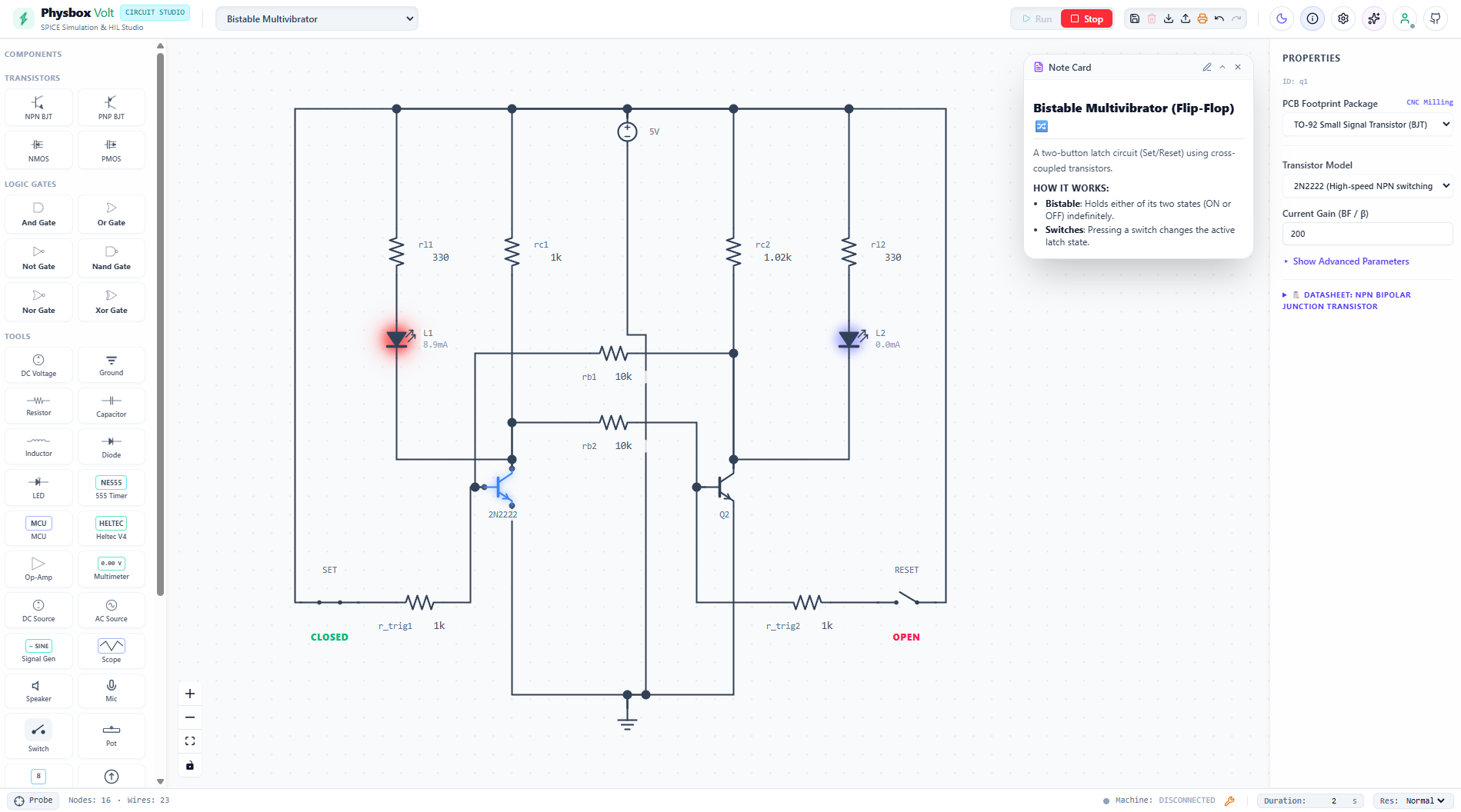
PhysBox: Volt

A full EDA (Electronic Design Automation) environment that runs entirely in the browser — schematic capture, netlist extraction and analog simulation on one canvas — powered by an optimized, custom-compiled Ngspice WebAssembly engine with real-time Hardware-In-The-Loop (HIL) execution. Design, wire, and test complex electrical circuits with true physical waveforms synchronized directly with physical microcontrollers.
  • Hardware-In-The-Loop Microcontroller Bridge: Wire physical ESP32 & CYD microcontrollers directly into the WASM SPICE worker via high-speed UART (460,800 baud) & WebSockets. Supports MicroPython & C++ native batching (`hil_batch`).
  • Integrated Audio Inputs & Outputs: Bind real hardware microphone inputs to input nodes, feed raw DAC outputs directly to your system speakers, and synthesize hardware filters in real time.
  • Visual React Flow Canvas & MCU Sandbox: Schematic capture in a modular node-editor — the EDA front end that compiles straight to the SPICE netlist the solver runs. Build and modify circuit nets, program microcontrollers inside the schematic, and execute firmware cycles alongside passive components.
Stylized Mockup Actual Screenshot
Physics Simulator Interface
Generative Physics 🛠️ OpenSCAD & 3D Printing

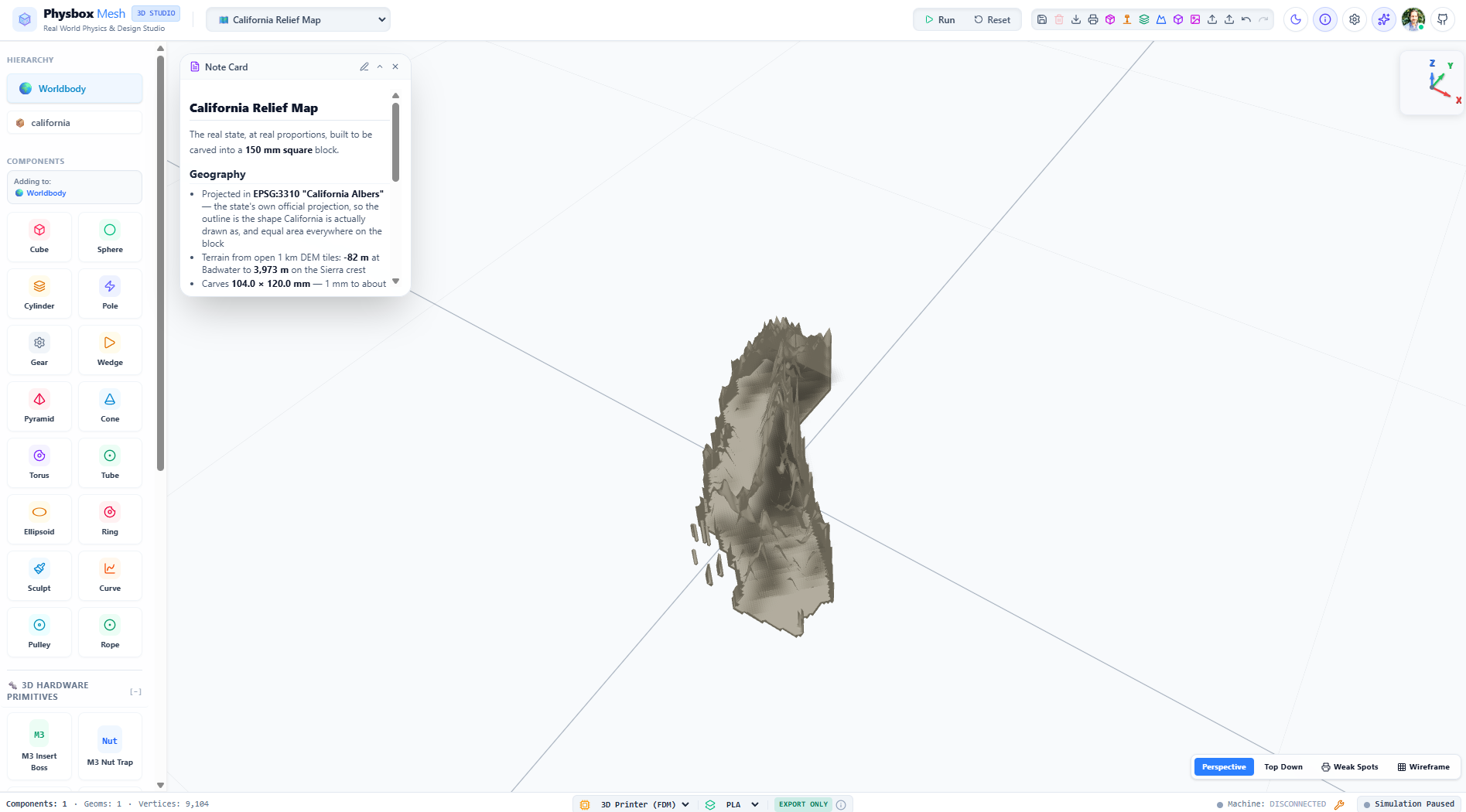
PhysBox: Mesh

Code. Simulate. Print. Powered by AI.
An advanced mechanical simulator powered by a custom-compiled MuJoCo WebAssembly engine and an integrated WASM OpenSCAD compiler. Generate parametric procedural CAD models, test physical joint mechanics in real time in a GPU-accelerated WebGL viewport, and export 3D-print ready STL files.
  • Procedural WASM OpenSCAD & Parametric Sliders: Write constructive solid geometry (CSG) code live inside the browser node inspector. Automatically compiles code and generates interactive UI sliders from annotations for instant tuning.
  • 1-Click Z-Up STL Export for 3D Printing: Export individual procedural components or full mechanical assemblies directly to Z-up orientation STL files, formatted specifically for modern slicers (PrusaSlicer, Bambu Studio, Cura).
  • Proximity-Aware Coupling & Complete DOF Control: Solves pinion, gear, and rack behaviors on the fly using rigid mathematical joint constraints, or uncheck coupling to test pure colliding gear teeth friction across 6-DOF bodies.
Stylized Mockup Actual Screenshot
PhysBox Etch Interface
2D Vector & CNC Studio 🔥 Laser Craft & WebSerial

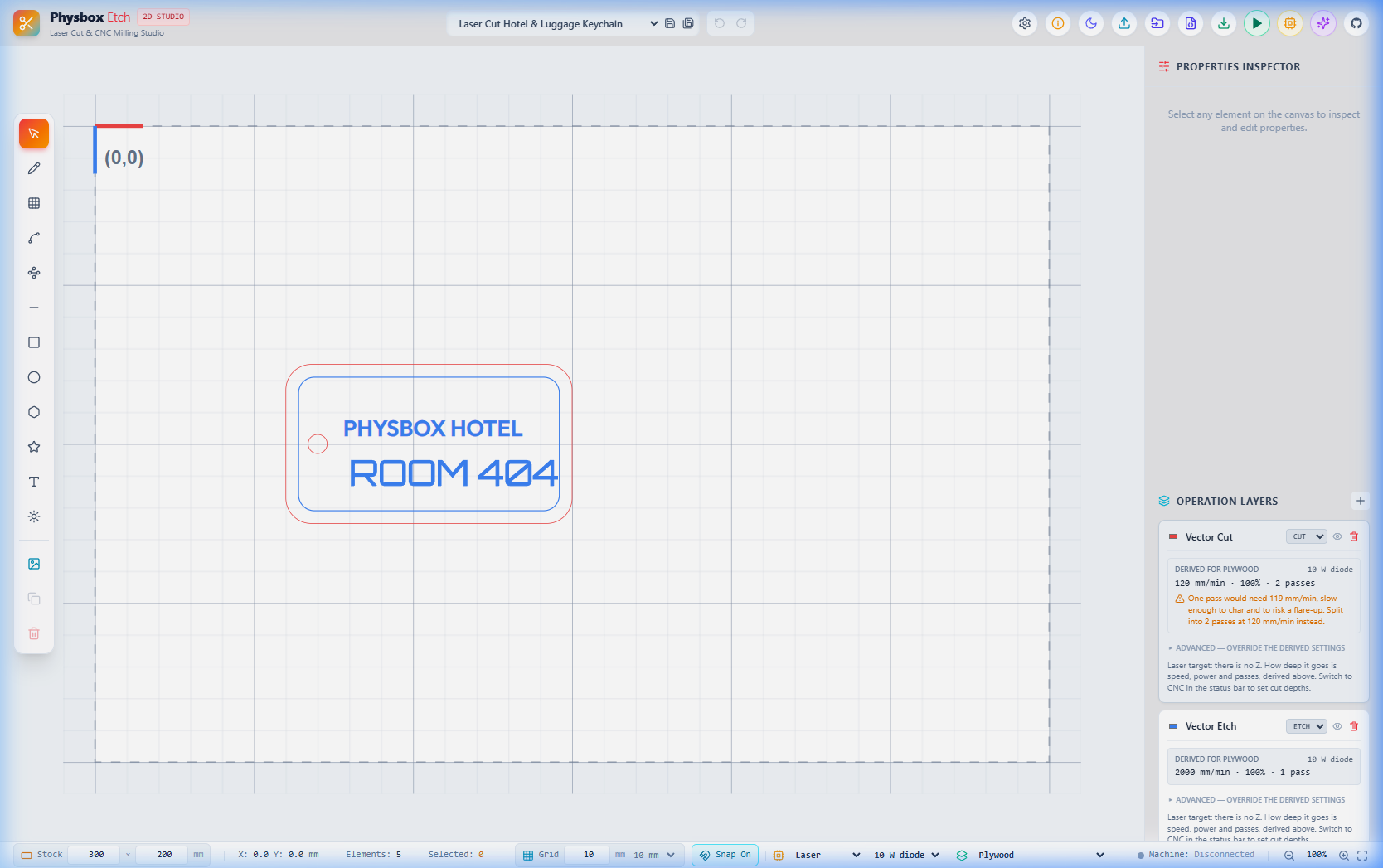
PhysBox: Etch

Vector Artistry. Laser Precision. Machine Control.
A studio for laser cutting, fine surface engraving, and CNC routing. Draw or import vector artwork, vectorize typography automatically, calculate material-specific feeds and kerf compensation, preview 3D G-code toolpaths, and stream directly to GRBL, FluidNC, or grblHAL hardware over WebSerial.

Natural Botanical & Contour Toolpaths Supports fine vector engravings, concentric tree growth ring contours, floral inlays, and kerf-tight organic wooden joinery.
Vector Cut
0.15mm optical kerf compensation with multi-pass stepdown tabs.
Vector Score
Fast vector tracing with low power for crisp surface joinery lines.
Raster Engrave
High-density bi-directional burnt fills for rich wood & acrylic depth.
Baltic Birch (3mm) Cast Acrylic (5mm) Walnut Hardwood Brass Inlay
  • Bed-Accurate Vector Canvas & Typography Vectorization: Real millimeter workspace with bezier node editing, mandala radial symmetry, and Google Fonts picker with automatic outline conversion so text cuts crisply without missing paths.
  • Intelligent Speeds, Feeds & Safety Warnings: Automatically derives spindle RPM, feed speeds, and pass stepdowns for Plywood, MDF, Hardwood, and Acrylic with live safety warnings for charring and carbide bit deflection.
  • Touch-Plate Z Probing & Bed Heightmaps: Zero work coordinates via G10 L20, probe Z zero with touch plates, and run 3x3 bed heightmaps so toolpaths follow warped stock or unlevel spoilboards seamlessly.
  • Raster Import & Clip Art Library: Bring a photo or logo in as traced vector, halftone dots, or engrave scanlines — or as a greyscale shade layer where darkness drives cut depth, so pitch, angle and depth stay editable afterwards. 40 built-in symbols across shapes, nature, tech and ornaments place at true millimeter size.
Stylized Mockup Actual Screenshot
Process Simulator Interface
Hybrid Systems & CA 🚧 Early Preview

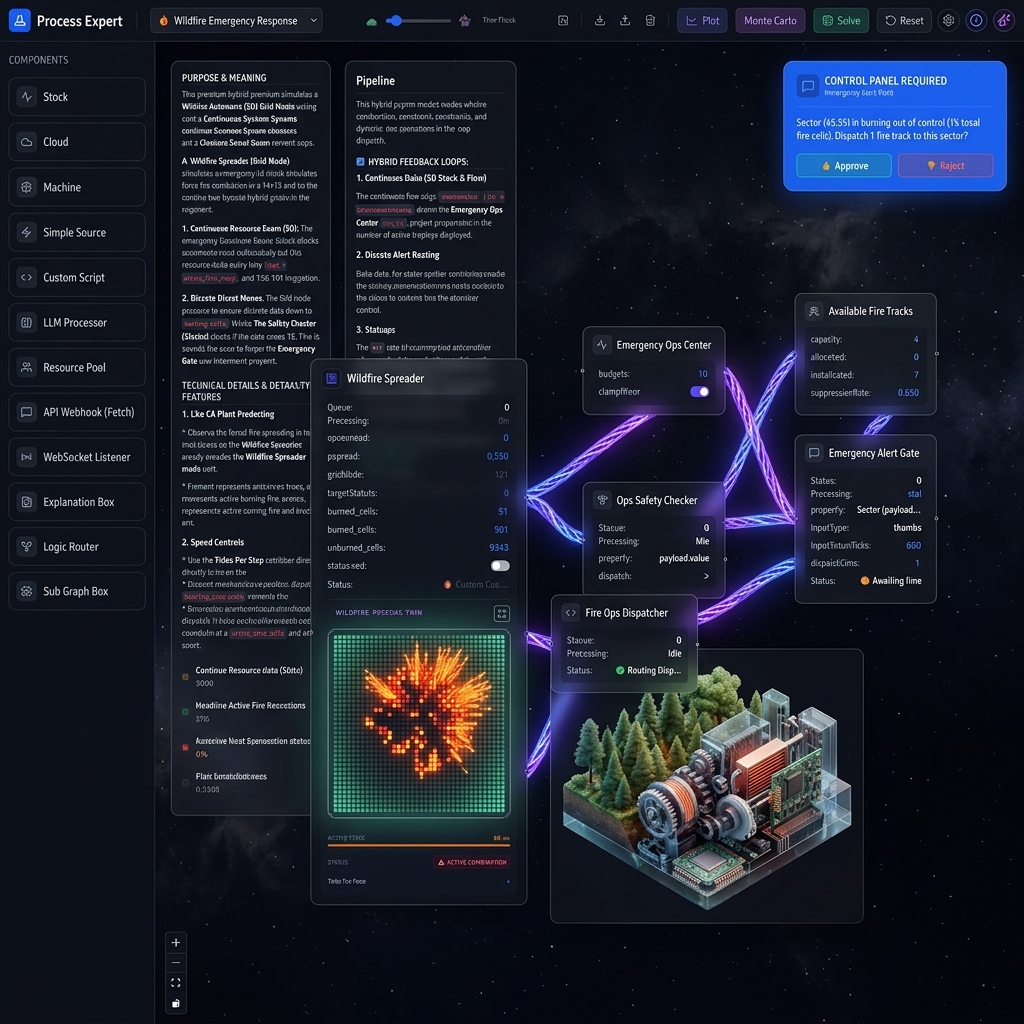
PhysBox: Flux

A hybrid systems simulator engineered to model complex relationships, cellular events, and system cycles. Bridge the gap between deterministic calculus and stochastic environmental cellular grids.

  • Runge-Kutta Differential Solver: Simulate multi-variable ecological balances, predator-prey dynamics, and process loops with numerical stability.
  • Wildfire Cellular Automata: Model pixel-by-pixel fire front spread, incorporating wind vectors, moisture, and response dispatch logic directly on an interactive 2D grid.
  • General IoT & Smart Nodes: Read real-world telemetry via WebSocket inputs and fire outbound webhooks for physical actions, combined with a State-Gated LLM Copilot to build grids safely.

Empowering AI Agents with Actionable Ground Truth — and the ability to create change in the physical world.

Bridging cognitive reasoning with physically grounded environments. physbox.io provides zero-latency local action spaces where agents can test layouts, solve physical problems, and safely interact with real-world machines.

Action Spaces Over Empty Logic

Large Language Models reason through text and code, but they operate in a physical vacuum. Without realistic feedback, an AI agent cannot correctly optimize an audio amplifier circuit, balance an unstable mechanical linkage, test a physical ESP32 HIL loop, or generate printable 3D CAD parts. They need grounded world models to solve complex, multi-modal tasks.

PhysBox solves this by exposing high-accuracy physical, hardware, and fabrication engines directly to AI agents. It provides a robust, local sandbox where agents can explore bounds, isolate failure points, and solve complex spatial problems.

AI AGENT SANDBOX

Native Interfaces for Agents

Built entirely on client-side WebAssembly, our simulators enable AI agents to bridge the gap between abstract reasoning and concrete physical execution. Every engine ships a first-class agent interface over the Model Context Protocol:

  • Native MCP Server, Not Brittle Scraping: physbox-mcp exposes the simulators as 81 typed Model Context Protocol tools over a local WebSocket relay. Agents call physics_build_scene or circuit_run_sim directly.
  • Procedural CAD & 3D Printing Generation: AI agents write and refactor OpenSCAD code to create custom brackets, gears, and enclosures, test structural stability in MuJoCo, and output 3D-printable STL files.
  • Real-World Hardware & Telemetry (HIL): Using WebSocket telemetry, serial HIL bridges, and general IoT webhooks, agents stream hardware pin states, read sensor values, and drive physical microcontrollers directly.
  • Iterative Design Self-Correction: Agents observe physical bounds and signal waveforms at 60fps, self-correcting schematic nets and CAD parameters until physical and functional requirements are met.

81 Tools. One pip install.

PhysBox: MCP is a companion server that puts every simulator on the other end of a tool call. Commands travel as JSON over a local WebSocket relay straight into the running browser tab. Seventy-nine are simulator tools; two more — detect_apps and send_command — work across all of them.

21 Volt tools SPICE runs, waveform reads, netlist edits, audio I/O
29 Mesh tools Scene building, SCAD validation, headless rollouts, STL export
13 Etch tools SVG & raster import, clip art, presets, machine capabilities, G-code
16 Flux tools Graph construction, solver control, telemetry — in preview

Connect in Two Steps

1

Install the companion server

pip install physbox-mcp
2

Register it with your MCP client

Drop this into .mcp.json for Claude Code, or ~/.gemini/config/mcp_config.json for Gemini in Antigravity.

{
  "mcpServers": {
    "physbox-mcp": {
      "type": "stdio",
      "command": "physbox-mcp",
      "args": ["--stdio"]
    }
  }
}

Open volt, mesh, etch, or flux.physbox.io and the page registers itself with the relay on load. Nothing else to wire up.

The Closed Loop

An agent designing a printable or laser-cut part doesn't just emit geometry and hope. It runs the full cycle, and the simulator gives ground truth feedback:

  1. physics_validate_scad Compile the OpenSCAD source. Returns vertex/face counts and a real-world bounding box — and flags the classic millimetre-vs-metre slip that silently builds a part 1000× too large.
  2. physics_build_scene Drop the compiled mesh into a MuJoCo scene with joints, actuators and constraints.
  3. physics_run_headless Run N ticks and return the trajectory without disturbing the live view. Rollouts for free.
  4. physics_get_telemetry / physics_get_screenshot Read numbers, or hand a rendered frame to a vision model. Both are one call.
  5. Correct and repeat. The part shrinks, the linkage stops binding, the amplifier stops clipping — because something other than the model's own confidence is grading the work.

Copy-Paste Agent Prompts for Claude Code & Cursor

Give your LLM immediate access to a physical world model. Copy any of these prompts directly into your MCP-connected agent:

Volt (Electronics)
"Optimize the RC filter values in Volt schematic to achieve a 1 kHz cutoff frequency, then run circuit_run_sim and return the magnitude plot."
Mesh (3D Physics & CAD)
"Write an OpenSCAD mounting bracket in Mesh with 4mm screw holes, test structural collision stability in MuJoCo, and export the Z-up STL."
Etch (CNC & Laser)
"Import this vector SVG logo, apply 2-pass 3mm stepdown feeds for Plywood, check CNC safety warnings, and generate GRBL G-code."

The Only AI-Native Physical World Model

Why traditional browser tools and desktop CAD/CAM leave AI agents in a physical vacuum—and how PhysBox gives LLMs ground-truth spatial, electronic, and physical feedback loops.

Feature / Capability Generic Web Solvers Desktop CAD / CAM ✨ PhysBox Suite
AI Agent Integration None (Manual UI only) Heavy Python Plugins 81 Native MCP Tools (AI-Native)
World Model Grounding Visual display only Offline file export Closed-loop physical ground truth
Local Data Privacy Server dependent Local software 100% Browser WASM (Zero Cloud Uploads)
Hardware-In-The-Loop (HIL) None Special hardware required WebSerial UART 460,800 baud
Zero-Install Access Browser URL Multi-GB installation Instant browser execution

Core Strengths

  • Zero friction instant web access with full WebAssembly simulation fidelity.
  • Native 81 MCP tools specifically built as physical world models for AI agents.
  • Bi-directional WebSerial hardware communication for real MCU & CNC controllers.
  • 100% offline-capable and private—your files never touch external cloud servers.

Honest Tradeoffs & Limitations

  • Browser WebAssembly memory caps (4GB) limit ultra-large multi-million node FEM meshes.
  • CAM is focused on 2.5D and 3D relief carving (no multi-axis 5-axis CNC support).
  • WebSerial allows 1 active hardware connection per browser tab.

Zero-Server Web Architecture

By compiling industry-standard C simulation engines and CAD compilers to WebAssembly, we deliver desktop-grade physics, HIL hardware, and 3D modeling directly in the browser.

WebAssembly Simulators

Native C simulation cores like Ngspice and MuJoCo compiled directly to WebAssembly for native-level execution speeds and complete browser sandboxing.

Hardware-In-The-Loop (HIL)

High-speed UART (460,800 baud) & WebSocket protocol linking WASM circuit solvers with MicroPython/C++ firmware running on physical ESP32/CYD microcontrollers.

WASM OpenSCAD & 3D Printing

Integrated CSG geometry engine compiling OpenSCAD code to MuJoCo collision meshes in WASM with live parametric UI sliders and 1-click STL export.

Laser Vector & CNC CAM

Real-time kerf offset calculations, SVG nesting, tab-and-slot finger joints, and WebSerial G-code streaming for laser cutters and CNC machines.

Our Open-Source Pledge

We believe scientific, maker, and educational tools should be accessible to everyone. physbox.io is completely free to use, contains no hidden tiers, requires no account creation, and will remain open-source forever. You can clone the repositories and run them offline locally.